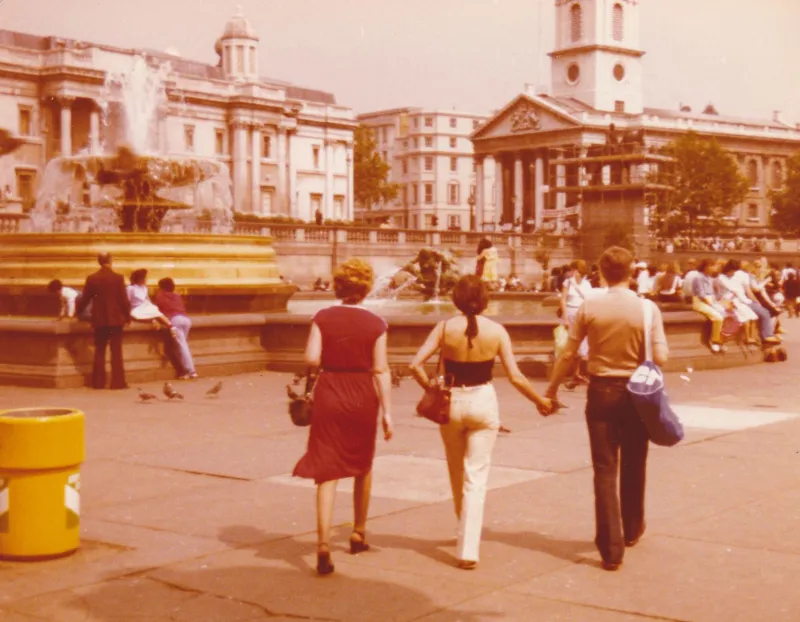
Dated on Arrival: The UK Buyer’s Audit for Stock Imagery With a Shelf Life

A stock image can be technically flawless and still be wrong by the time it reaches a bus shelter. The expiry date is rarely printed on the file. It sits in a jacket lapel, a phone bezel, a shop sign, a banknote or a strand of tinsel. For UK buyers in 2026, the question is not simply whether an image is licensed. It is whether the visual will still say what the campaign needs it to say after twelve or eighteen months in market.
A Period Look Is Not the Same as an Expiry Date
Some images are meant to evoke an era. A brief for a heritage brand may deliberately call for retro styling, analogue cameras or period shopfronts. That is a creative choice. The procurement risk begins when an image is meant to feel current, neutral or forward-looking but carries accidental date cues. A 1970s styling reference is safe because it is intentional. A 2019 office with wired headphones, a pre-pandemic meeting room or a discontinued payment terminal is not. The test is simple: if the image is used in 2027, will the viewer see the intended message or the year?
That distinction should be recorded in the procurement file. Buyers should mark assets as either deliberately retrospective or intended as neutral. Only the second category needs a formal shelf-life review.
Where UK Visuals Reveal Their Age
The most common date cues are ordinary objects. Fashion is an obvious one, but the risk is less about a single garment than about a cluster of signals: trainers, lanyards, workplace dress codes, sunglasses shapes and the cut of a suit. Technology is faster still. Phone models, laptop ports, payment terminals, smart meters and electric vehicle charging connectors all carry a visible generation. A CCS connector may look modern today; a CHAdeMO cable may read as legacy equipment. Neither is wrong, but the buyer should know which story the frame is telling.
Shopfronts and streets are especially vulnerable in the UK. Fascia brands change, estate agent boards are replaced, vacant units acquire new tenants, bus stops are redesigned and road markings are repainted. Temporary signage from the pandemic period still appears in older libraries: one-way systems, QR menus and floor stickers. Those are history, not generic street furniture. The same applies to commemorative decor. Jubilee and coronation bunting belongs to a specific moment; it should not be briefed as general celebration imagery unless the campaign is explicitly historical.
Currency and civic symbols also date a frame. Bank of England notes carrying a particular monarch portrait, coin designs, royal cyphers and post-Brexit product markings all narrow the usable life of an image. Vehicle number plates are a particularly British tell: a 26 plate reads as 2026, while an older prefix or suffix reveals the capture year at a glance. Seasonal decor is no different. Christmas lights, advent calendars and Easter displays follow design cycles. A winter campaign can be timeless; a Christmas 2024 prop cannot.
A Four-Question Audit for the Procurement File
First, establish the capture date. Upload date is not capture date, and metadata is often stripped during editing. Ask the supplier for the original capture date and record it alongside the asset. If the supplier cannot provide it, note the uncertainty rather than assuming the image is recent.
Second, make a short object inventory for each shortlisted image. List the elements that carry a date: clothing, technology, legible text, logos, number plates, currency, signage and decor. This does not need to be forensic. A three-line note is enough to show that the buyer looked.
Third, check whether the metadata is fit for procurement. Alt text and keywords should describe what is actually in the frame, not what the buyer wishes were there. If an image is tagged as modern workplace but shows a discontinued handset, the accessibility metadata is misleading as well as the visual. That is a procurement issue, not a pedantic one.
Fourth, read the licence terms for duration and restriction. Most UK stock licences are perpetual, but perpetual permission is not the same as perpetual relevance. Ask about editorial-only limits, model and property releases, and any clause that restricts use after a defined period. A licence can be valid for a decade while the image is commercially exhausted in eighteen months.
Requesting Better Metadata and Updated Terms
Buyers should not be shy about asking for a time-sensitivity note. A useful supplier response will state the capture date, the location, the release status and any known date cues. For high-spend campaigns, it is reasonable to request an updated frame from the same shoot or a re-shoot of the same concept. The cost of asking is almost always lower than the cost of a recall, a reprint or an emergency replacement.
Where a supplier cannot confirm the capture date, the buyer should treat the image as higher risk. That does not mean automatic rejection. It means the asset should be priced, briefed and approved with that uncertainty in view.
The False Economy of the Cheaper Frame
A discounted image with a 2018 capture date can look like a bargain until the retouching, legal review and replacement costs are added. A more useful measure is cost per usable month. Add the licence fee, the editing time, the internal review and the likely replacement cost, then divide by the number of months the campaign will run. An image that saves £200 but needs replacing after nine months is rarely cheaper than a well-dated frame that runs for two years.
The same logic applies to campaign extensions. A visual that was acceptable for a six-week promotion may become a liability when the campaign is extended into a second year. Procurement teams should build a review point into long-running campaigns rather than assuming that a perpetual licence guarantees perpetual fitness.
Briefing for Longevity
The strongest defence is the brief. Ask for visuals that avoid date-stamping: no legible brands, no identifiable phone models, no year-specific signage and no commemorative decor unless the story is historical. Brief the season rather than the year. Winter light, wet pavements and wool coats will outlast a specific Christmas display. Ask for timeless but not sterile. The aim is not an image without context; it is an image whose context will not expire before the media plan does.
The clock is part of the composition. UK buyers should treat it as a licensable element, record the audit and keep the evidence with the file. If an image cannot be dated, it cannot be properly defended when the campaign outlives the frame.