The Fifty-Metre Test: Stock Imagery Standards for UK Out-of-Home Media in 2026
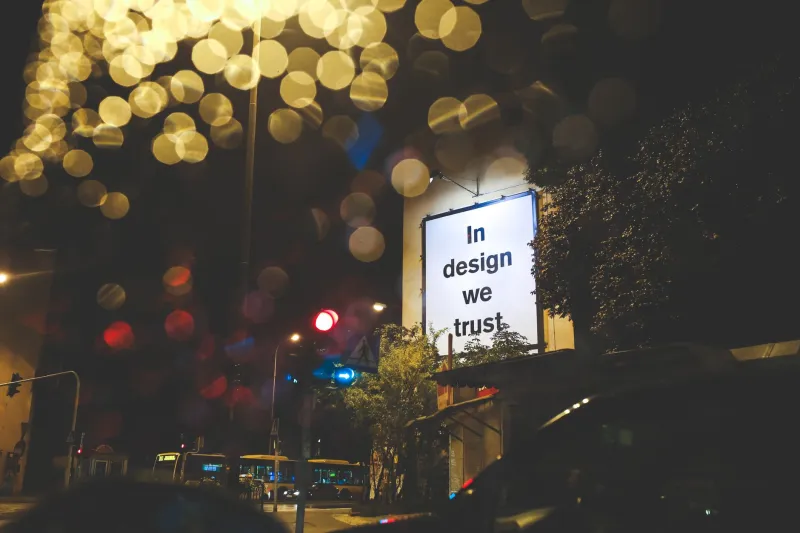
Out-of-home advertising is unforgiving. A web banner is viewed at arm's length and can be swapped within hours; a poster on a UK bus shelter or a 48-sheet beside a trunk road is judged at fifty metres, in daylight, by an audience that has no context beyond the frame. The same stock photograph can serve both purposes, but only if the licence and the file are examined before the artwork is signed off. Moving an image from digital to physical media changes what the buyer needs to prove, not merely what the buyer needs to supply.
Resolution is a floor, not a strategy
The first question in most production meetings is whether a file is large enough. The honest answer depends on viewing distance rather than on a single figure. A four-sheet bus shelter panel measuring roughly 1016 mm by 1524 mm, viewed from a pavement a few metres away, demands more than a 48-sheet viewed from a moving vehicle. Printers will often quote an effective resolution at final size, and a practical range for large-format work commonly sits between 25 and 50 dots per inch, with the higher end reserved for close-viewed panels.
That tolerance is not a licence to upscale. Interpolation can soften fine detail, exaggerate compression artefacts and produce banding in graduated skies, all of which become conspicuous on a large substrate. Buyers should inspect the master file at 100 per cent, check for chroma noise in shadows and confirm that the image has not already been resaved at a lower quality. Where digital out-of-home screens are involved, the requirement shifts again: screens have fixed pixel dimensions, brightness levels and refresh characteristics, so a file that is technically large enough may still fail on contrast or colour rendition.
The crop is part of the licence conversation
UK out-of-home formats are not interchangeable. Portrait four-sheets, landscape 48-sheets and the wider 96-sheet all impose different aspect ratios, and a photograph composed for a square social post will rarely survive the transition without losing its subject or its sense of place. The temptation is to crop tightly to fit the panel; the risk is that the crop removes the very element that made the image usable, or pushes a released model out of frame while leaving an unreleased passer-by in it.
A more reliable approach is to brief for headroom from the outset. Images with generous margins, simple backgrounds and a clear focal point can be reframed across several formats without a second licence. Where a campaign runs across multiple sites, the artwork may need a master file plus a set of approved crops, each checked against the original release. It is worth recording those crops in the campaign file so that a later adaptation does not quietly exceed what was agreed.
What out-of-home means in the small print
Standard stock licences are frequently written for digital and modest print use. Out-of-home advertising is often treated as a separate, higher-tier application because of its public visibility, its reach and the difficulty of withdrawing a poster once it is pasted up. Some licences exclude billboard, roadside or transit advertising altogether; others permit it only under an extended licence with defined limits on campaign duration, territory or number of sites.
Buyers should look for explicit wording rather than assume that a general commercial licence covers a national poster campaign. Questions worth putting to the supplier include whether the licence extends to digital out-of-home, whether multiple sites and multiple campaign flights are included, whether category exclusivity is required and whether the licence survives if the campaign is extended. Print run limits, impression caps and restrictions on use in sensitive contexts can all affect the decision. A licence that is adequate for a regional bus shelter rollout may be inadequate for a national roadside buy, and the difference is usually cheaper to resolve before production than after installation.
Releases under a street lamp
Out-of-home raises the stakes on model and property releases. A recognisable person in a poster is exposed to a far larger audience than in a targeted online advertisement, and the law and the licence terms both reflect that. Where an image shows identifiable individuals, a model release should be checked for the specific use, including whether advertising is permitted and whether the release covers the intended territory and duration. Images of children, or of people in sensitive settings, warrant particular care.
Property releases matter equally. Recognisable buildings, interiors, private land and distinctive architectural features may require permission, and UK buyers should be alert to listed buildings, London landmarks and locations managed by heritage bodies. Incidental inclusion of street furniture, shopfronts or logos can also create clearance questions at large format, where details that were invisible on a screen become legible. Where a release is absent, the safest course is usually to select a different frame rather than to rely on a retoucher.
Timelines and approvals
Large-format production has a longer critical path than digital. Media owners publish artwork specifications, colour profiles and copy deadlines, and late files can miss a posting window entirely. Prepress checks commonly reference ISO 12647-2 for colour management, and proofs should be assessed under appropriate lighting rather than on an uncalibrated office monitor.
Campaigns also need to satisfy the advertising codes administered by the Advertising Standards Authority. That is primarily a matter for the advertiser, but stock imagery can affect compliance where claims, depictions or endorsements are implied. Allowing time for legal and brand review, as well as for media owner approval, is more realistic than assuming a file can be turned around in the same week as a social asset.
The line items buyers forget
Budgeting for out-of-home stock usually extends beyond the download fee. Extended licensing, exclusivity, retouching, colour correction, upscaling, additional format versions and re-approval across sites all carry costs. So does the administrative work of tracking which image version ran where, and for how long. For campaigns that may be repeated, it is worth confirming at the outset whether the licence can be renewed on predictable terms.
A short checklist helps: confirm the file is a genuine master; verify the licence covers out-of-home and digital out-of-home; check releases against the intended use; brief for crop headroom; and build approval time into the production schedule. The fifty-metre test is unforgiving, but it is also fair. An image that is properly licensed and properly prepared will hold up in the street as well as it did on the screen.